Optimization Result
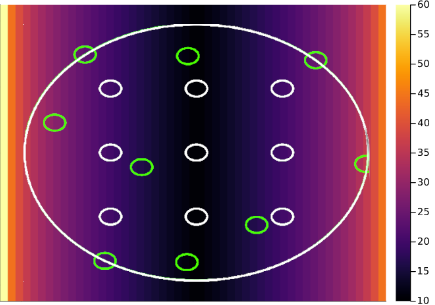
An example optimization output. The original layout can be seen in white, the optimized layout is represented in green.
Brigham Young University
Provo, UT
August 2022 - May 2023
Julia, Optimization,
Non-Linear Programming
This project aimed to develop a tool that optimizes turbine layout in offshore wind farms to minimize the Levelized Cost of Energy (LCOE). As part of my role in Brigham Young University’s FLOW Lab, I designed and implemented an optimizer that considers wind speed, wind direction, and water depth—each impacting power output and foundation costs. By refining turbine positioning, the tool achieved substantial reductions in LCOE across various depth profiles.

The optimizer was coded in Julia using the BYU FLOW Lab's FLOWFarm and SNOW libraries, which support non-linear optimization and turbine property calculations. To address offshore-specific challenges, I expanded these libraries with functions that dynamically calculate monopile foundation costs based on turbine depth, wind loads, and material properties. This enhancement involved determining monopile dimensions according to depth and steel yield stress, which allowed for accurate cost estimation based on material mass. The optimization used a gradient descent approach with automatic differentiation, iteratively reducing LCOE by adjusting turbine placements to identify an optimal configuration.
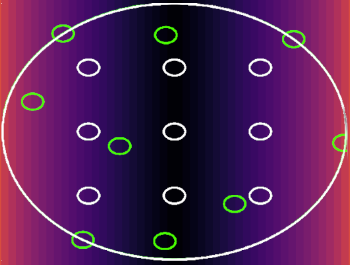
The optimizer consistently reduced LCOE by 7-10% across different test cases:
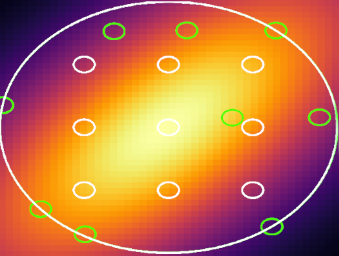
An example optimization output. The original layout can be seen in white, the optimized layout is represented in green.
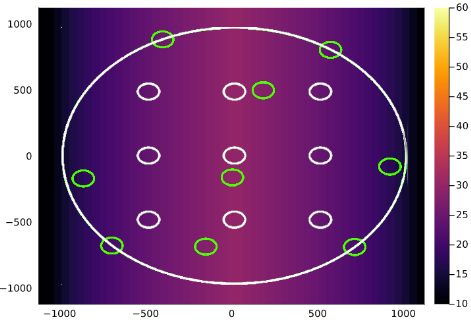
An example optimization output. The original layout can be seen in white, the optimized layout is represented in green.
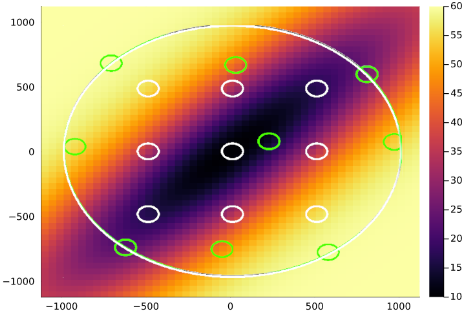
An example optimization output. The original layout can be seen in white, the optimized layout is represented in green.
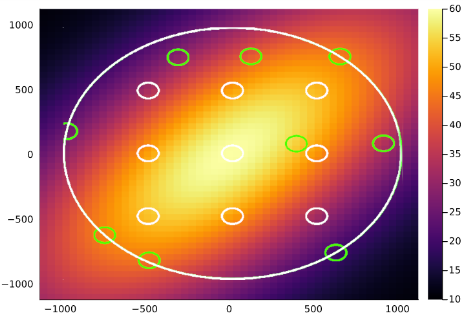
An example optimization output. The original layout can be seen in white, the optimized layout is represented in green.